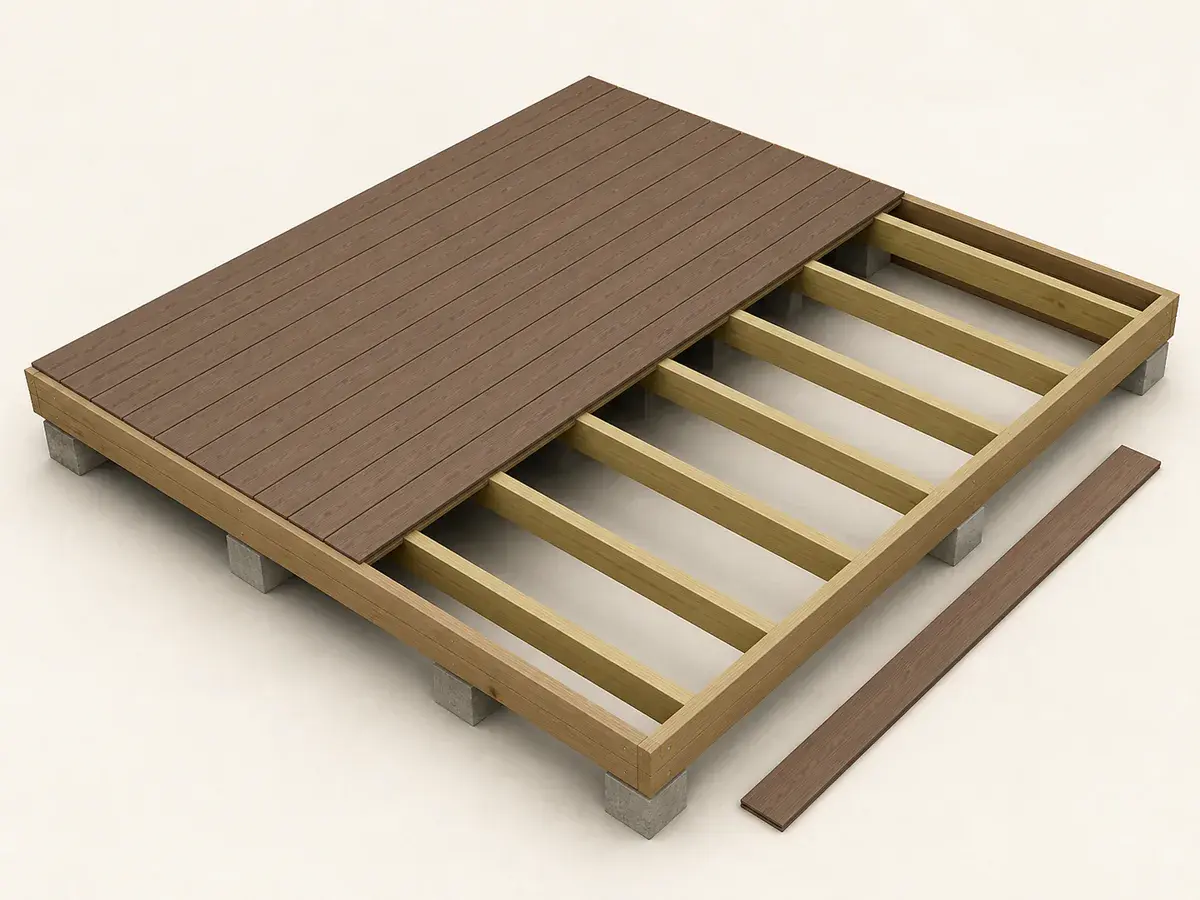
A decision you can check
- 01
Confirm board compatibility
Use clips, plugs or screws listed for the exact board profile and framing material. Generic fasteners may void product instructions.
- 02
Map special boards
Picture frames, breaker boards, stair treads and ripped edge boards often need face or plug fastening even when the field uses clips.
- 03
Set gap and movement
Follow side, end and structure-clearance requirements for material and installation temperature.
- 04
Plan replacement access
Understand how a damaged interior board can be removed and whether clips remain accessible from above.
Write a specification someone else can check
Hidden does not mean maintenance-free; fastener corrosion compatibility and framing condition still matter.
Overdriven face screws can trap water or distort composite surfaces.
- Confirm board compatibility
- Map special boards
- Set gap and movement
- Plan replacement access
Convert the decision into quantities
Enter the measured geometry in the Decking Calculator, replace defaults with the selected product coverage and round only at the final purchasable unit. List accessories and preparation materials separately so a coverage change does not silently scale unrelated items.
Guards, stairs and structural connectors require separate fastening schedules.
Verify at order and delivery
Check the exact local designation or product code, performance class, size, colour or batch where relevant, stated coverage, yield, density or capacity, ordered quantity and accessory compatibility on the written order. Inspect delivered deck surface before installation and isolate damaged or mismatched material while return and replacement options remain open.
What usually throws the order off
- Comparing board price without the fastening system
- Installing new boards over unchecked framing
- Using one gap in every temperature
- Assuming hidden clips work at every border
Frequently asked questions
What must the deck surface specification identify?
Make the scope checkable against these decisions: confirm board compatibility; map special boards; set gap and movement; plan replacement access. Record the exact local designation or product, performance class, dimensions, finish where relevant, accessories and controlling technical document.
Which calculator default changes after product selection?
Replace whichever default the exact deck surface controls—coverage, yield, density, dimensions, package quantity or capacity—while keeping the verified project geometry unchanged.
Who should approve a substitution?
The owner and responsible designer or installer should confirm in writing that the substituted deck surface preserves required performance, appearance, compatibility, installation method and documented supplier or project acceptance criteria.
Technical references
These references support the measurement and planning method. Product instructions, the site and applicable local requirements control the final installation.