A decision you can check
- 01
Map every board run
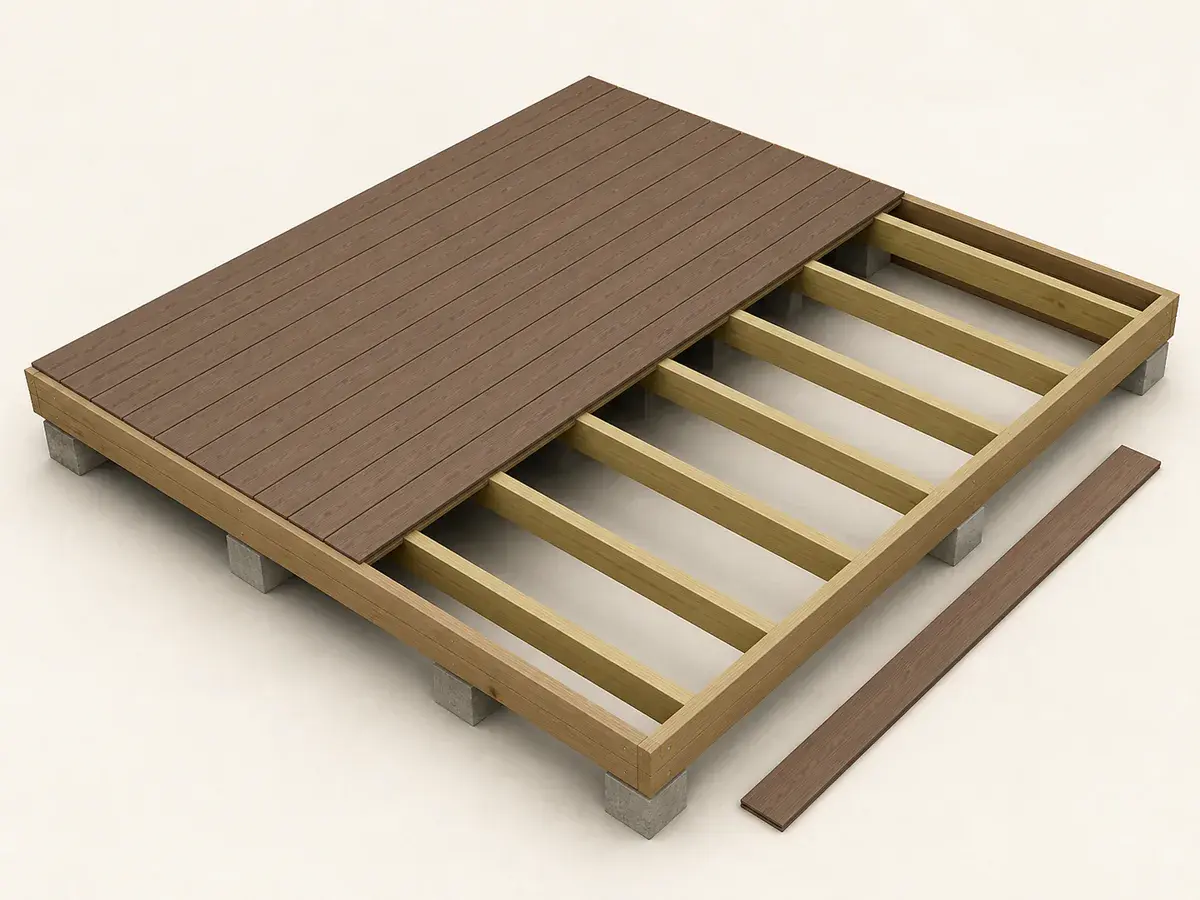
Separate the main field, borders, stairs and fascia. Record where breaker boards split long runs.
- 02
Overlay available lengths
Test supplier stock lengths against the run schedule and required joint locations. Do not assume a nominal length provides zero end trimming.
- 03
Plan supported joints
Place every end joint over suitable framing and follow product requirements for spacing, fasteners and end gaps.
- 04
Reserve replacements
Keep matching boards for damaged high-traffic areas, especially with capped composite products whose colour line may change.
Make the allowance explainable
Diagonal fields and mitred borders create more offcuts than straight square layouts.
Composite expansion rules can vary by product and installation temperature.
- Map every board run
- Overlay available lengths
- Plan supported joints
- Reserve replacements
Keep related materials separate
The decking takeoff excludes structural framing, footings, guards and stairs unless those are calculated separately.
Use the Decking Calculator to test alternatives without changing the original site measurement. Adjust one assumption at a time—such as package coverage, layout allowance or product size—so the effect on the deck boards order remains understandable.
Buy from the final specification
Check the final deck boards quantity or capacity against exact product data, available purchase units and the supplier return policy. Record any lot, colour or matching-spare requirement that truly applies, but do not keep material that cannot be stored safely or usefully. Confirm installation requirements before delivery.
What usually throws the order off
- Using nominal instead of actual board width
- Leaving a very narrow final row
- Counting area without stock lengths and supported joints
- Treating framing and surface-board quantities as one estimate
Frequently asked questions
Is a larger deck boards result automatically safer?
No. Apply only the quantity adjustment supported by layout, handling, product guidance, site conditions and final purchase units. Excess can raise cost, handling and disposal without improving the project.
Can one default allowance fit every project?
No. Treat defaults as early planning inputs, then replace them after reviewing the actual deck boards geometry, selected product data, installation method, site conditions and purchase increments.
When should a qualified installer or supplier confirm the final order?
Before the order becomes non-returnable and again after site conditions or design details change. Reconcile the measured takeoff with the selected product and planned installation method.
Technical references
These references support the measurement and planning method. Product instructions, the site and applicable local requirements control the final installation.