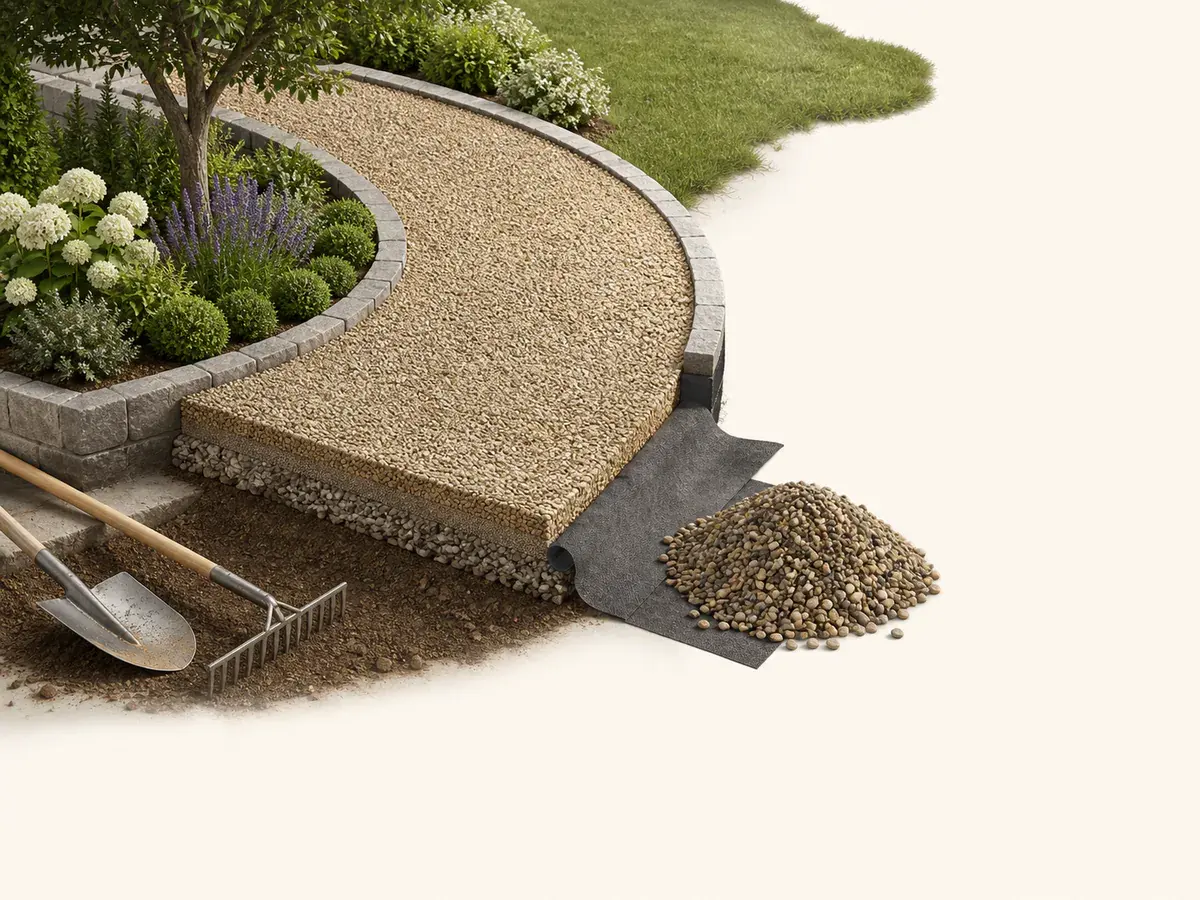
A decision you can check
- 01
Diagnose when ruts appear
Observe after rain and under wheel paths. Soft pumping, standing water and displaced dry stone suggest different corrections.
- 02
Restore drainage and shape
Open outlets, rebuild crown or cross slope and prevent concentrated roof or hillside runoff from crossing the drive uncontrolled.
- 03
Repair the structural layer
Remove soft contamination where necessary and rebuild with a suitable graded base compacted at workable moisture.
- 04
Finish and maintain edges
Apply the selected surface course, compact where appropriate and maintain shoulders or restraint so traffic does not push the drive wider.
Diagnose the mechanism before adding material
Repeatedly filling ruts with clean round stone can create a loose channel without correcting support.
Geotextile can separate weak soil from aggregate in a designed section but does not drain trapped water by itself.
- Diagnose when ruts appear
- Restore drainage and shape
- Repair the structural layer
- Finish and maintain edges
Use quantity as a controlled repair input
Once the cause and repair boundary are established, use the Gravel Calculator to measure only the affected gravel driveway scope. Preserve the original dimensions and state any added repair allowance so buying more material does not hide an unresolved site problem.
Snow plowing and aggressive turning can move surface stone even on a sound base.
Set a stop line
Stop and obtain qualified help when the condition involves structure, active water entry, electrical or gas systems, unstable surfaces, fall exposure, uncertain hazardous material or a requirement outside ordinary visual and non-invasive checks. Failure-prevention guidance is not a promise that an assembly will never move, wear or need maintenance.
What usually throws the order off
- Using one aggregate for every layer
- Ignoring water outlets
- Dumping one thick uncompacted lift
- Filling ruts without diagnosing the base
Frequently asked questions
Can extra gravel driveway prevent this failure?
Usually not by itself. Extra stock can cover a defined replacement boundary, but it cannot correct the mechanism. For this project, remember: Snow plowing and aggressive turning can move surface stone even on a sound base.
Should I repair the visible gravel driveway symptom first?
Document the symptom and its extent first. Begin diagnosis with this check: Observe after rain and under wheel paths. Soft pumping, standing water and displaced dry stone suggest different corrections. Correct active safety, water or movement causes before concealing the evidence.
When should work stop for professional review?
Stop when the condition is structural, rapidly changing, wet from an unknown source, electrically unsafe, difficult to access safely or outside the selected gravel driveway system.
Technical references
These references support the measurement and planning method. Product instructions, the site and applicable local requirements control the final installation.