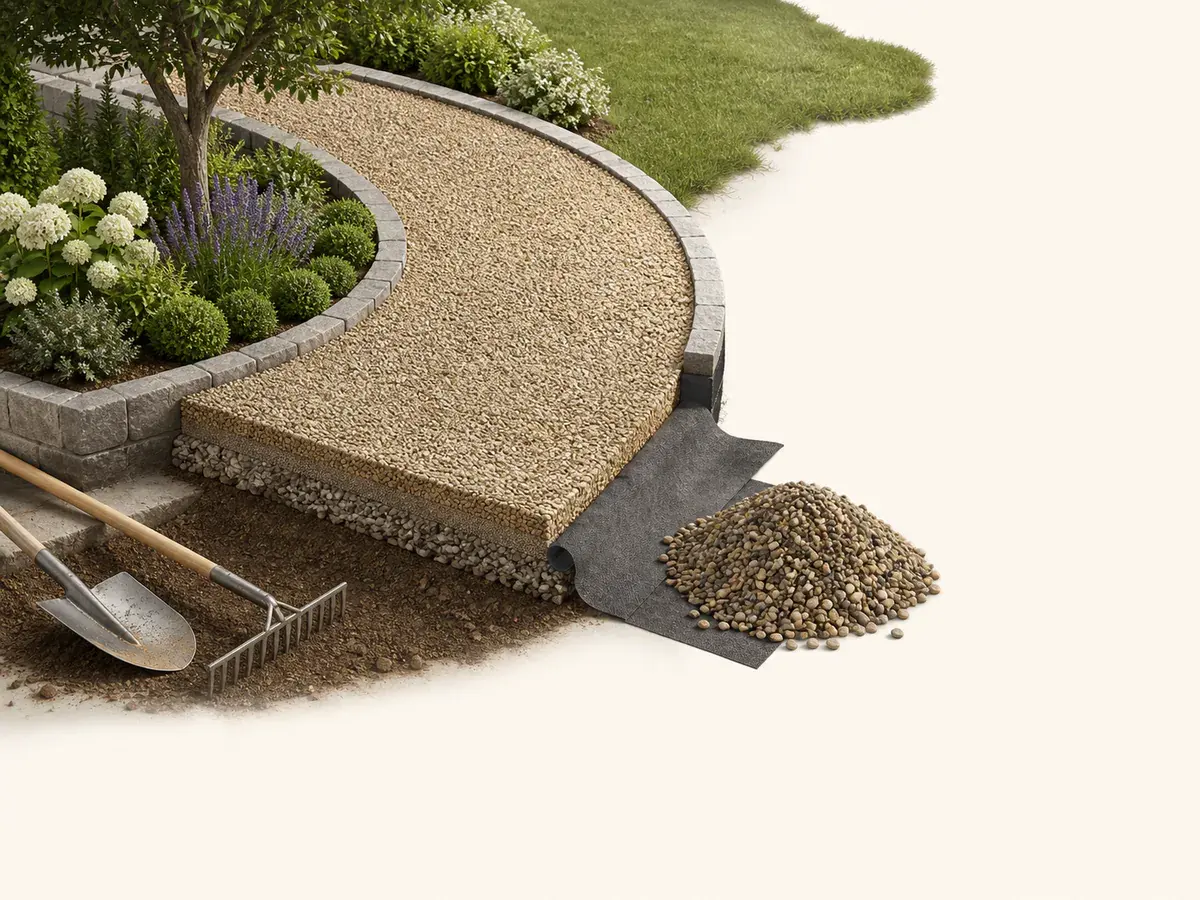
A decision you can check
- 01
Dense graded crushed stone
A blend of sizes and fines can compact into a stable base when properly placed. Drainage behaviour differs from clean open-graded stone.
- 02
Clean angular stone
Washed or open-graded aggregate can support drainage applications but may not form the same tight walking surface.
- 03
Rounded pea gravel
Small rounded particles provide a decorative loose surface. Strong edging and regular raking may be needed, especially on slopes.
- 04
Confirm the complete system
Compare the selected aggregate surface with preparation, accessories, labour, maintenance and replacement needs. Record the exact product rather than carrying a generic category into the order.
Compare performance before price
A permeable-looking stone surface is not automatically a designed permeable pavement; the base and outlet control water.
Supplier names such as crusher run, road base or number 57 vary by region.
- Dense graded crushed stone
- Clean angular stone
- Rounded pea gravel
Use the calculator without hiding the choice
Keep the verified project dimensions fixed in the Gravel Calculator, then change only the package coverage, unit size or waste assumption that belongs to the selected aggregate surface. This shows the cost of the decision without changing the room or site.
Stability depends on gradation, layer depth, compaction and subgrade—not angularity alone.
Approve a real sample and specification
Review the exact product or a representative sample in the project conditions, read the current technical data and write the locally recognized designation or product line, performance class, size, finish where relevant and accessory system into the purchase scope. Availability and installer experience can make a technically acceptable option impractical locally.
What usually throws the order off
- Ordering by a generic gravel name
- Assuming every crushed stone drains the same
- Using a universal density after choosing a quarry product
- Selecting a dump point without truck access
Frequently asked questions
Which aggregate surface option is best?
There is no universal winner. Use the crushed stone vs pea gravel criteria to eliminate options that do not meet the location, exposure, substrate or maintenance requirement, then compare complete installed systems.
Can I compare options by advertised price alone?
No. Convert each aggregate surface option to the same finished scope and include its preparation, accessories, delivery, installation, maintenance and replacement implications.
Can appearance or a sample approve the order?
No. A sample helps judge appearance; current technical documents establish performance, installation limits, warranty and the quantity or capacity represented by the exact aggregate surface.
Technical references
These references support the measurement and planning method. Product instructions, the site and applicable local requirements control the final installation.