A decision you can check
- 01
Name the exact product
Use the quarry or supplier designation, not only a broad term such as gravel. Ask whether the quote is by ton or cubic yard.
- 02
Get the bulk density
Request a conversion for that product and expected moisture condition. Record it beside the estimate so the assumption is visible.
- 03
Separate loose and compacted states
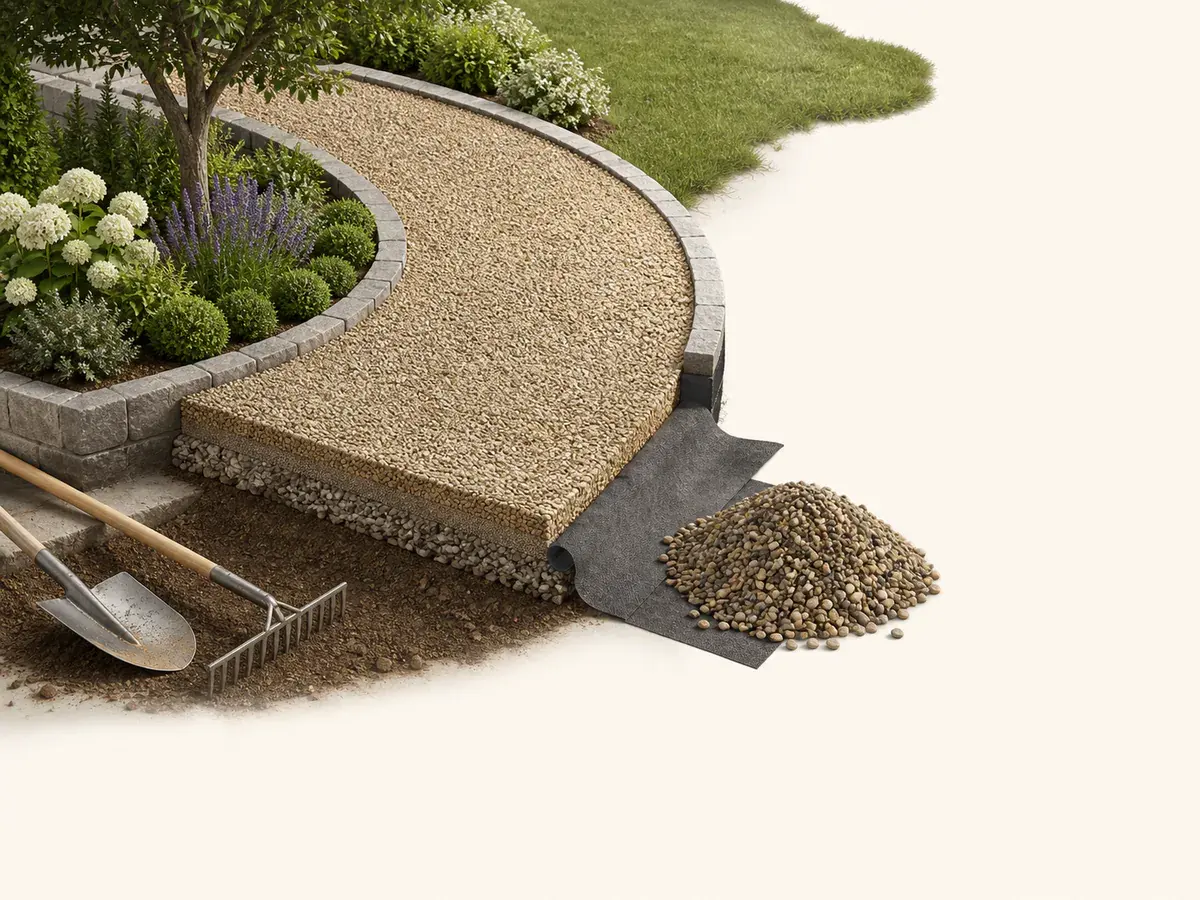
The installed layer is compacted while the truck carries loose aggregate. Include the supplier's compaction or ordering recommendation.
- 04
Check truck and site limits
Coordinate payload, delivery minimum, road access, dump location and whether multiple loads are needed to avoid overloading surfaces.
Make the allowance explainable
Density conversion errors scale with the whole project; changing the depth after ordering is often even more significant.
Washed decorative stone and dense graded aggregate can have different voids and handling behaviour.
- Name the exact product
- Get the bulk density
- Separate loose and compacted states
- Check truck and site limits
Keep related materials separate
Weigh tickets provide delivered mass but do not prove that subgrade, depth or compaction meets the project requirement.
Use the Gravel Calculator to test alternatives without changing the original site measurement. Adjust one assumption at a time—such as package coverage, layout allowance or product size—so the effect on the gravel order remains understandable.
Buy from the final specification
Check the final gravel quantity or capacity against exact product data, available purchase units and the supplier return policy. Record any lot, colour or matching-spare requirement that truly applies, but do not keep material that cannot be stored safely or usefully. Confirm installation requirements before delivery.
What usually throws the order off
- Using one depth for base and surface layers
- Treating loose and compacted volume as identical
- Using a generic density after selecting a specific aggregate
- Ignoring delivery truck access and payload
Frequently asked questions
Is a larger gravel result automatically safer?
No. Apply only the quantity adjustment supported by layout, handling, product guidance, site conditions and final purchase units. Excess can raise cost, handling and disposal without improving the project.
Can one default allowance fit every project?
No. Treat defaults as early planning inputs, then replace them after reviewing the actual gravel geometry, selected product data, installation method, site conditions and purchase increments.
When should a qualified installer or supplier confirm the final order?
Before the order becomes non-returnable and again after site conditions or design details change. Reconcile the measured takeoff with the selected product and planned installation method.
Technical references
These references support the measurement and planning method. Product instructions, the site and applicable local requirements control the final installation.