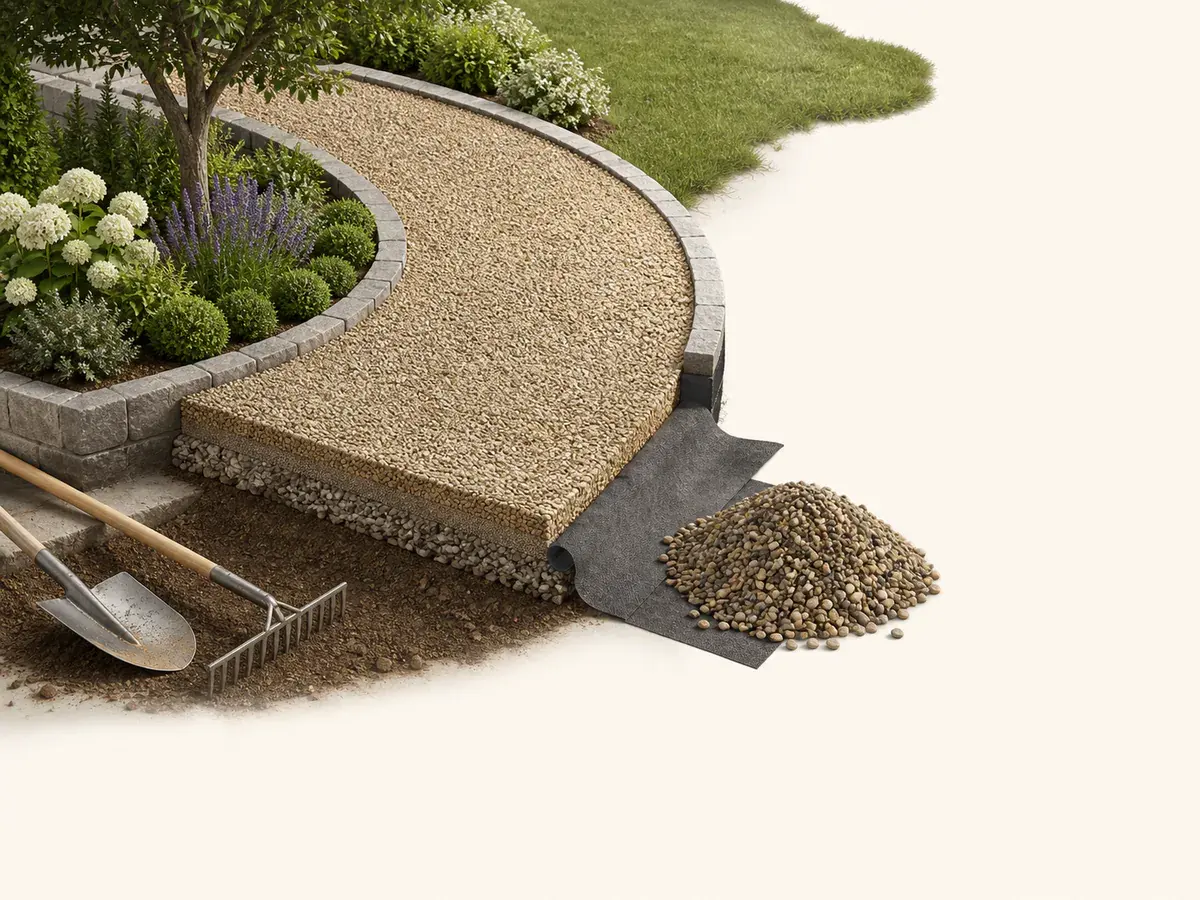
A decision you can check
- 01
Confirm the system
Check forecast, groundwater, drainage outlet and haul-route bearing condition.
- 02
Verify site conditions
Proof the prepared subgrade and correct soft areas before placing aggregate.
- 03
Protect the work
Stage geotextile, edge restraint and drainage components before deliveries queue.
- 04
Set the release gate
Place and compact in controlled lifts under the project specification.
Conditions that change the plan
Very dry aggregate may also require controlled moisture for effective compaction.
A delivery truck can damage the same subgrade the finished gravel is intended to protect.
- Check forecast, groundwater, drainage outlet and haul-route bearing condition.
- Proof the prepared subgrade and correct soft areas before placing aggregate.
- Stage geotextile, edge restraint and drainage components before deliveries queue.
- Place and compact in controlled lifts under the project specification.
Connect timing to the quantity
Use the Gravel Calculator only after the work area and product system are defined. Quantity, package count and cost do not prove that the gravel surface can be delivered, installed, cured or returned to service under the current conditions. Keep the measured gravel surface baseline, then price its protection, staging and delays separately so a schedule change does not silently corrupt the takeoff.
Frozen ground can hide soft conditions that reappear after thaw.
Create a written gravel surface release decision
For best weather and site conditions for gravel installation, record the selected product, relevant site readings, start time and controlling instruction beside the project record. The protection step is specific: Stage geotextile, edge restraint and drainage components before deliveries queue. Release the next activity only after this check is complete: Place and compact in controlled lifts under the project specification. If the measured gravel surface condition leaves the permitted range, stop and reassess instead of extending a generic clock.
What usually throws the order off
- Dumping over saturated subgrade
- Counting truckloads as proof of compacted depth
- Opening to heavy vehicles first
- Hiding soft spots under decorative gravel
Frequently asked questions
Can I use a universal rule for best weather and site conditions for gravel installation?
No. The gravel surface decision follows the exact product instructions and project specification. This condition can change the plan: Very dry aggregate may also require controlled moisture for effective compaction.
Does the Gravel Calculator account for weather or storage?
It calculates a transparent gravel surface material baseline. Add its protection, delivery, storage, labour remobilization and rejected material as separate scope and cost decisions.
What should I document before best weather and site conditions for gravel installation moves to the next step?
Keep the gravel surface product labels, timing, relevant readings and protection method together with the release rule. The final field check is: Place and compact in controlled lifts under the project specification.
Technical references
These references support the measurement and planning method. Product instructions, the site and applicable local requirements control the final installation.