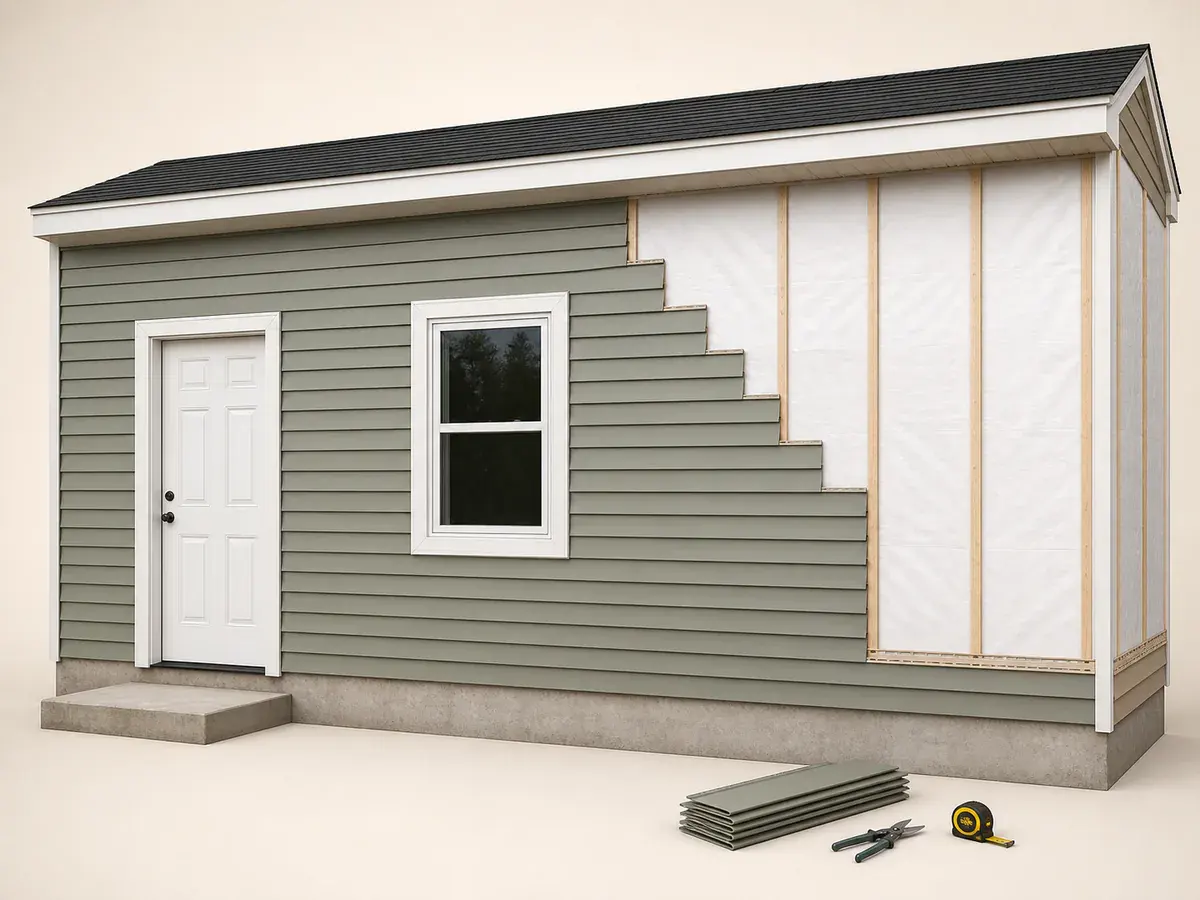
A decision you can check
- 01
Prepare a flat drained wall
Repair sheathing, install the specified water-resistive barrier and complete window, door and roof-wall flashing before field panels.
- 02
Set accessories and clearances
Install starter, corners, opening channels and utility blocks plumb with the product's expansion spaces.
- 03
Fasten without pinning
Centre fasteners in slots where required, leave the specified clearance under heads and avoid face nailing ordinary panels.
- 04
Inspect movement and drainage
Check that panels slide, laps face away from main views where planned and weep or drainage paths remain open.
Diagnose the mechanism before adding material
Buckling can result from tight nails, short end clearance, fixed penetrations or heat reflected from nearby glass.
Siding is a cladding, not the primary flashing at windows and roof intersections.
- Prepare a flat drained wall
- Set accessories and clearances
- Fasten without pinning
- Inspect movement and drainage
Use quantity as a controlled repair input
Once the cause and repair boundary are established, use the Siding Calculator to measure only the affected siding installation scope. Preserve the original dimensions and state any added repair allowance so buying more material does not hide an unresolved site problem.
Caulk should be used only at locations intended by the system; sealing drainage exits can worsen water retention.
Set a stop line
Stop and obtain qualified help when the condition involves structure, active water entry, electrical or gas systems, unstable surfaces, fall exposure, uncertain hazardous material or a requirement outside ordinary visual and non-invasive checks. Failure-prevention guidance is not a promise that an assembly will never move, wear or need maintenance.
What usually throws the order off
- Treating gables like rectangular walls
- Reusing directional rake offcuts blindly
- Nailing vinyl panels tight
- Relying on face caulk instead of flashing
Frequently asked questions
Can extra siding installation prevent this failure?
Usually not by itself. Extra stock can cover a defined replacement boundary, but it cannot correct the mechanism. For this project, remember: Caulk should be used only at locations intended by the system; sealing drainage exits can worsen water retention.
Should I repair the visible siding installation symptom first?
Document the symptom and its extent first. Begin diagnosis with this check: Repair sheathing, install the specified water-resistive barrier and complete window, door and roof-wall flashing before field panels. Correct active safety, water or movement causes before concealing the evidence.
When should work stop for professional review?
Stop when the condition is structural, rapidly changing, wet from an unknown source, electrically unsafe, difficult to access safely or outside the selected siding installation system.
Technical references
These references support the measurement and planning method. Product instructions, the site and applicable local requirements control the final installation.