Calculators/Concrete

Concrete Calculator

Plan slab volume in cubic yards or cubic metres, plus common bag quantities.

Free · No signup · Reviewed August 22, 2026
Step 1
Set your project size

Use the finished area you plan to cover, then refine the assumptions below.
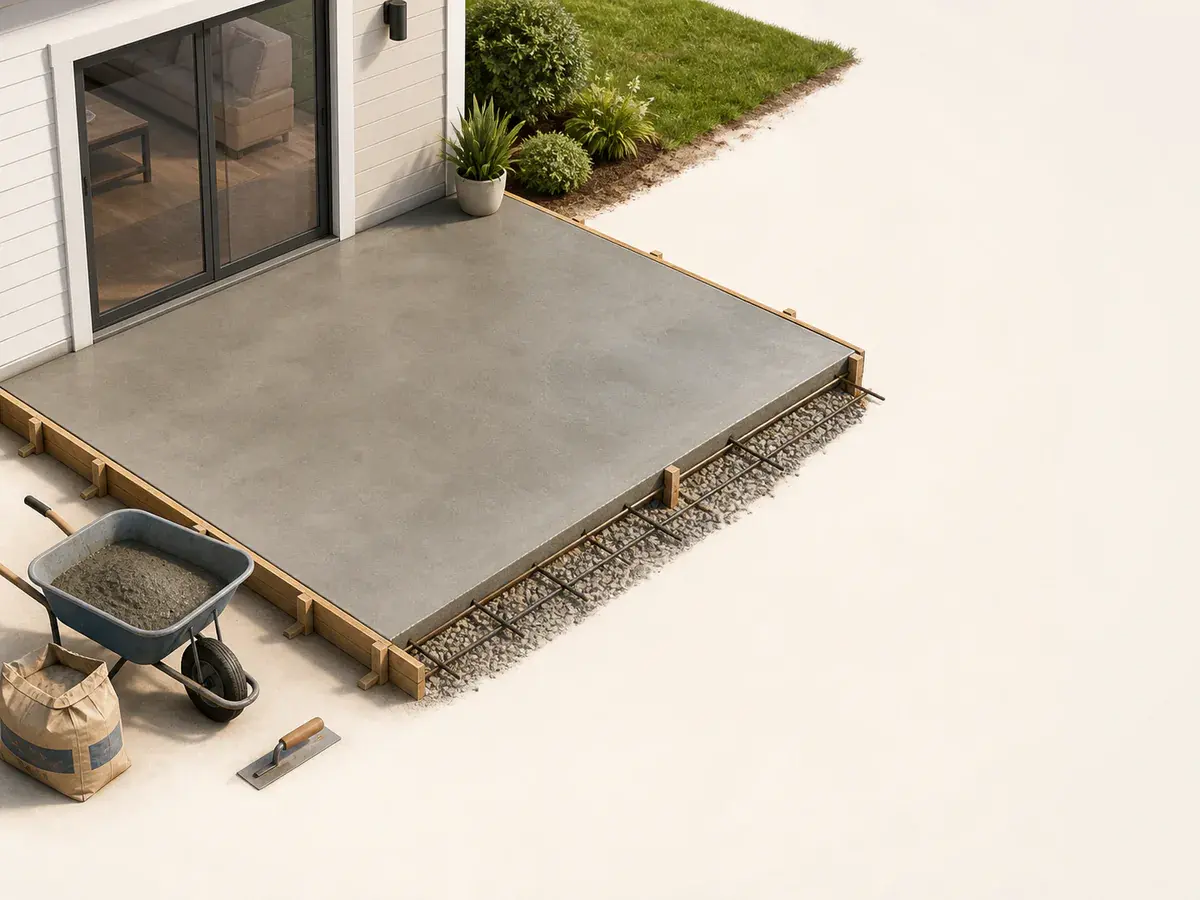
Step 2 · Visual referenceCheck the active area
Residential concrete slab project reference
Surface area120 ft²Installed depth4 inRaw volume1.48 yd³

Why it mattersConfirm the slab surface, installed depth and raw volume.

Reference image; figures update from your measurements.

You’ll need

1.56 cubic yards
Shopping list
1.56bulk cubic yards
7080 lb bags (alternative)
1 slab$256.67 primary material estimate

Project shopping list

Use your result as a starting point, then confirm package coverage, product instructions and local requirements before purchasing.

MaterialConcretePackageready-mix yd³AllowanceIncluded

How the calculation works

length × width × depth

Enter each project area, choose the measurement system, then adjust waste and real package coverage. Packaged materials round up so the shopping list never suggests part of a box, sheet or panel.

MEASURE WITH CONFIDENCE

How to use the concrete calculator

Enter the finished slab length, width and thickness. ProjectMeter converts the volume to cubic yards or cubic metres and also shows an 80 lb bag alternative, with waste applied before quantities are rounded.

Formula and guidance reviewed August 22, 2026. Always confirm the final order with product instructions and project requirements.
STEP BY STEP

What to measure

  1. 01

    Measure the form interior

    Use the inside length and width of the forms—the space the concrete will actually fill.

  2. 02

    Check thickness in several places

    Excavation and subbase variation can change volume. Use a planned finished thickness that meets the project specification.

  3. 03

    Separate different shapes

    Add patios, landings or slab sections separately instead of forcing an L-shaped project into one rectangle.

  4. 04

    Choose delivery or bags

    Compare the ready-mix volume with the bag alternative, then consider access, mixing capacity, delivery minimums and placement time.

WORKED EXAMPLE

12 × 10 ft slab at 4 in thick

  • Rectangular slab
  • 5% waste
  • 80 lb bags at 0.6 cu ft yield
Calculated result

The estimate is 1.56 cubic yards, or about 70 80-lb bags as an alternative. A ready-mix supplier may require ordering in its own increments.

Try your own measurements ↑
AVOID COSTLY REWORK

Common mistakes before you buy

  • Confirm thickness, reinforcement, base preparation and joints before ordering.
  • Ready-mix suppliers may have minimum loads, short-load fees and fixed delivery windows.
  • Never reduce a structural specification just to match a smaller order quantity.
FROM QUANTITY TO BUDGET

Compare the complete project cost

Your material quantity is only one part of a quote. Preparation, removal, access, finishing and local labour can change the installed total.

Pour a concrete patio$1,919–$5,393Estimate an installed concrete patio by size, thickness, finish, preparation and reinforcement.Read cost guide →Pour a concrete driveway$2,700–$14,500Plan a driveway by area, thickness, base, reinforcement, finish, demolition, drainage and vehicle load.Read cost guide →
MEASURE BEFORE YOU ORDER

Planning guides for this calculator

Use the live model for feedback, then use these guides to verify the dimensions and material assumptions behind the result.

Measure & estimateConcrete Depth and Volume PlanningConvert finished slab dimensions into concrete volume while accounting for depth changes, base preparation and placement reality.Read guide →Choose & planReady-Mix Concrete vs BagsCompare bagged concrete with ready-mix delivery using yield, crew pace, access, minimum orders and placement time.Read guide →Compare materials3,000 PSI vs 4,000 PSI ConcreteUnderstand what specified compressive strength means and why adding cement or water on site is not a reliable design method.Read guide →Specify & buyRebar vs Wire Mesh for ConcreteCompare reinforcement forms without treating steel quantity as a substitute for slab or joint design.Read guide →Plan a projectShed Slab Concrete PlanningPlan a small shed slab from finished footprint, edge detail, base, anchorage, access and one coordinated placement.Read guide →Avoid failuresHow to Reduce Concrete Cracking and CurlingUnderstand controllable causes of random cracks and lifted slab edges before forms, joints and curing are finalized.Read guide →Time the workCold-Weather Concrete PlanningCoordinate mixture, subgrade, protection, finishing and curing before a cold-weather placement.Read guide →Protect & maintainHot-Weather Concrete Curing and Return to ServiceReduce rapid moisture loss and set a defensible release gate for traffic or loads.Read guide →Manage the projectConcrete work: Budget, Quotes, Safety and CloseoutManage a complete concrete work project from measured quantity and comparable bids through safety checks, maintenance records and final acceptance.Read guide →Worked exampleConcrete for a 10 × 10 SlabConvert a 10 ft by 10 ft slab at 4 in thick into cubic yards and a practical ready-mix planning quantity.Read guide →Worked exampleConcrete for a 12 × 12 SlabWork a 12 ft square, 4 in slab from cubic feet to a two-cubic-yard ready-mix estimate.Read guide →Worked exampleConcrete for a 24 × 24 Garage SlabEstimate the flat-field volume of a 24 ft square garage slab while keeping structural edges and design decisions visible.Read guide →
TAKE THE PLAN TO THE SITE

Interactive project checklists

Use the pre-order list before material arrives, then save the inspection and maintenance list for closeout and future care.

CONCRETE · READYConcrete Pour Readiness ChecklistLock forms, volume, access, reinforcement, labour and curing before the truck or mixer starts.Open 12-task checklist →CONCRETE · CAREConcrete Slab Closeout and Care ChecklistDocument placement, curing, joints and early condition before loading or coating a new slab.Open 12-task checklist →
COMMON QUESTIONS

Concrete calculator FAQ

Should I round concrete up?

Yes. Small variations in subgrade, forms, spillage and leftover material can cause a shortfall. The editable waste allowance helps, but the final order should follow the supplier and project specification.

How many 80 lb bags equal one cubic yard?

At an estimated 0.6 cubic feet of yield per bag, one cubic yard takes about 45 bags before waste. Check the yield statement on the exact mix you buy.

Can I use this for footings or columns?

This version models rectangular sections. Divide a footing into rectangular runs. Circular piers and columns need a circular-volume calculator or an engineer-approved takeoff.

Plan accurately. Build safely.

This calculator is a planning estimate, not engineering or code approval. Follow manufacturer instructions and consult a qualified professional for structural, electrical, gas or permit-sensitive work.