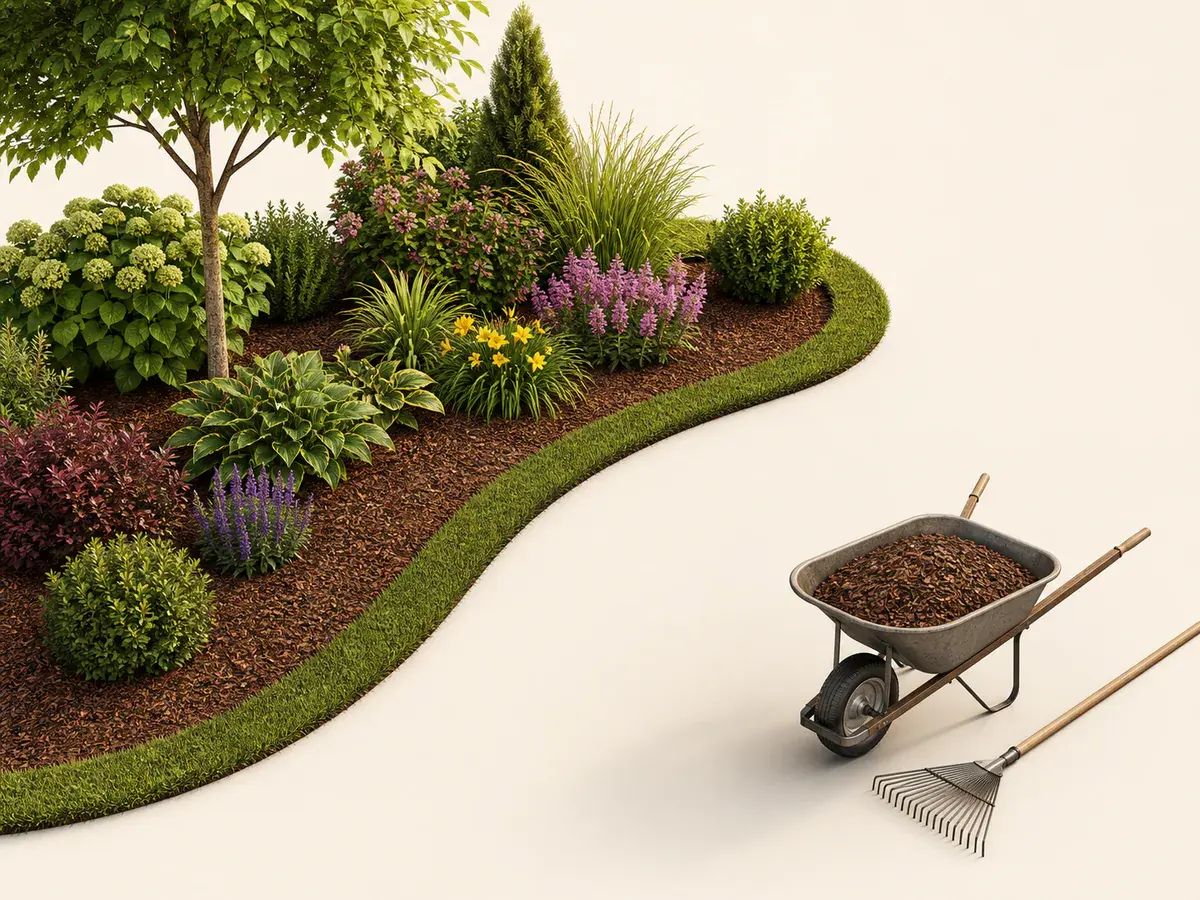
A decision you can check
- 01
Identify the feedstock
Confirm whether the product is bark, arborist chips, clean recycled wood or another source and whether it is suitable around the intended plants.
- 02
Inspect particle distribution
Excessive fines can mat while very large pieces leave open soil. Look at an actual pile rather than choosing from a small colour chip.
- 03
Test the visual area
Use one product across connected beds so wet and dry colour variation is intentional. Bright dyes can dominate young planting.
- 04
Plan renewal by condition
Re-measure remaining depth and top up only what has decomposed or moved; do not add a full layer each calendar year automatically.
Write a specification someone else can check
Colour retention varies with sun, rainfall and particle wear.
Mulch choice cannot correct drainage, root flare burial or an unsuitable planting location.
- Identify the feedstock
- Inspect particle distribution
- Test the visual area
- Plan renewal by condition
Convert the decision into quantities
Enter the measured geometry in the Mulch Calculator, replace defaults with the selected product coverage and round only at the final purchasable unit. List accessories and preparation materials separately so a coverage change does not silently scale unrelated items.
Local arborist chips can be a practical resource when their source and intended use are understood.
Verify at order and delivery
Check the exact local designation or product code, performance class, size, colour or batch where relevant, stated coverage, yield, density or capacity, ordered quantity and accessory compatibility on the written order. Inspect delivered landscape mulch before installation and isolate damaged or mismatched material while return and replacement options remain open.
What usually throws the order off
- Choosing stone only because it lasts
- Ignoring heat around plants
- Buying dyed mulch without asking the feedstock
- Adding a full new depth every year
Frequently asked questions
What must the landscape mulch specification identify?
Make the scope checkable against these decisions: identify the feedstock; inspect particle distribution; test the visual area; plan renewal by condition. Record the exact local designation or product, performance class, dimensions, finish where relevant, accessories and controlling technical document.
Which calculator default changes after product selection?
Replace whichever default the exact landscape mulch controls—coverage, yield, density, dimensions, package quantity or capacity—while keeping the verified project geometry unchanged.
Who should approve a substitution?
The owner and responsible designer or installer should confirm in writing that the substituted landscape mulch preserves required performance, appearance, compatibility, installation method and documented supplier or project acceptance criteria.
Technical references
These references support the measurement and planning method. Product instructions, the site and applicable local requirements control the final installation.