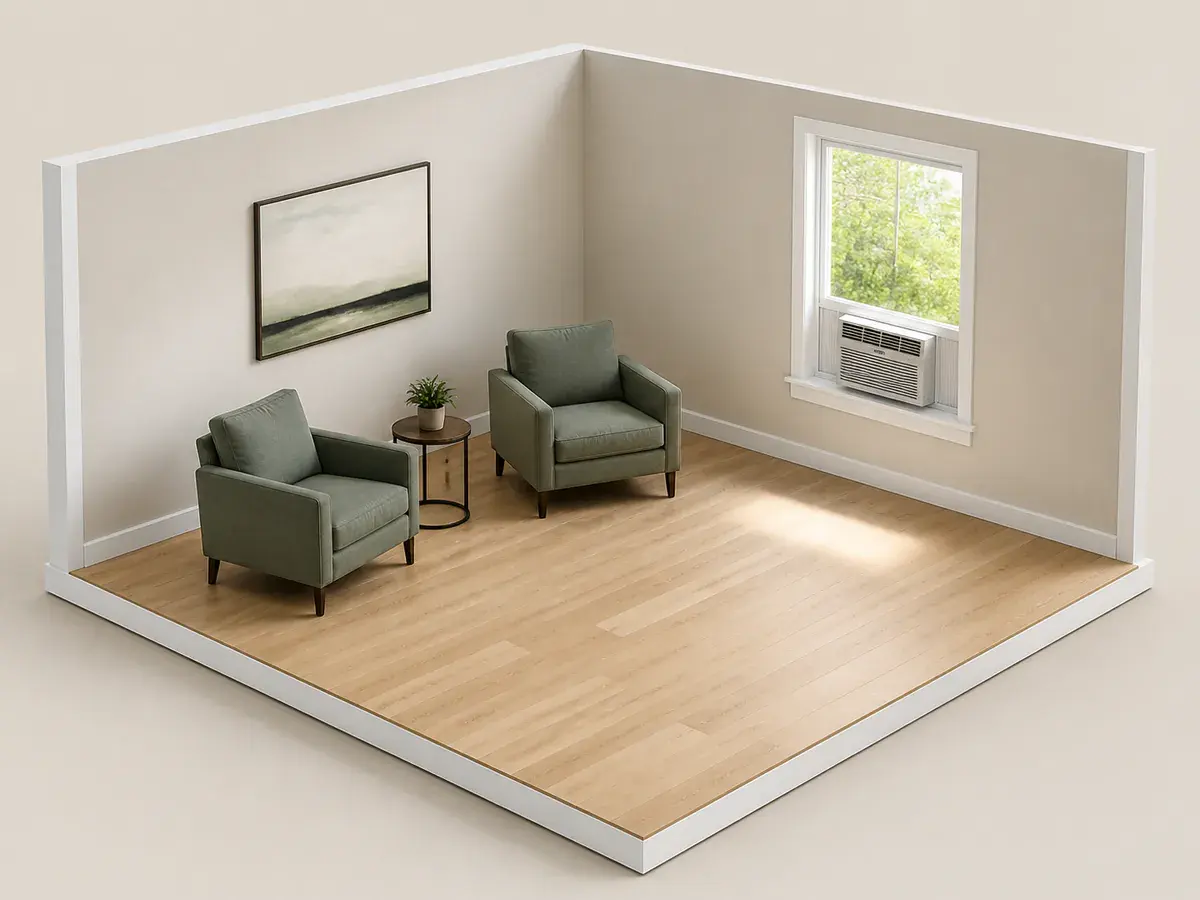
A decision you can check
- 01
Recheck room sizing
Compare floor area, sun, occupants and kitchen use with the published capacity guidance. Do not combine closed rooms into one nominal load.
- 02
Restore airflow
Clean the user-serviceable filter, clear indoor and outdoor discharge and keep curtains or furniture from recirculating cold air into the intake.
- 03
Control moisture sources
Use bathroom and kitchen exhaust, correct water entry and keep doors or windows closed during humid operation.
- 04
Observe the cycle safely
Record run time, room temperature, humidity and error indicators. Follow the manufacturer before resetting or seeking qualified service.
Diagnose the mechanism before adding material
A very low thermostat setting does not make a fixed-capacity unit remove heat faster.
Fan-only or continuous-fan modes can affect how moisture on the coil returns to room air.
- Recheck room sizing
- Restore airflow
- Control moisture sources
- Observe the cycle safely
Use quantity as a controlled repair input
Once the cause and repair boundary are established, use the Room AC BTU Calculator to measure only the affected bedroom room AC scope. Preserve the original dimensions and state any added repair allowance so buying more material does not hide an unresolved site problem.
A dirty filter is a safe first check, but sealed refrigerant, electrical and compressor work is not a DIY diagnostic.
Set a stop line
Stop and obtain qualified help when the condition involves structure, active water entry, electrical or gas systems, unstable surfaces, fall exposure, uncertain hazardous material or a requirement outside ordinary visual and non-invasive checks. Failure-prevention guidance is not a promise that an assembly will never move, wear or need maintenance.
What usually throws the order off
- Sizing multiple closed rooms as one
- Ignoring window and circuit dimensions
- Buying extra BTU for faster cooling
- Blocking return or discharge airflow
Frequently asked questions
Can extra bedroom room AC prevent this failure?
Usually not by itself. Extra stock can cover a defined replacement boundary, but it cannot correct the mechanism. For this project, remember: A dirty filter is a safe first check, but sealed refrigerant, electrical and compressor work is not a DIY diagnostic.
Should I repair the visible bedroom room AC symptom first?
Document the symptom and its extent first. Begin diagnosis with this check: Compare floor area, sun, occupants and kitchen use with the published capacity guidance. Do not combine closed rooms into one nominal load. Correct active safety, water or movement causes before concealing the evidence.
When should work stop for professional review?
Stop when the condition is structural, rapidly changing, wet from an unknown source, electrically unsafe, difficult to access safely or outside the selected bedroom room AC system.
Technical references
These references support the measurement and planning method. Product instructions, the site and applicable local requirements control the final installation.