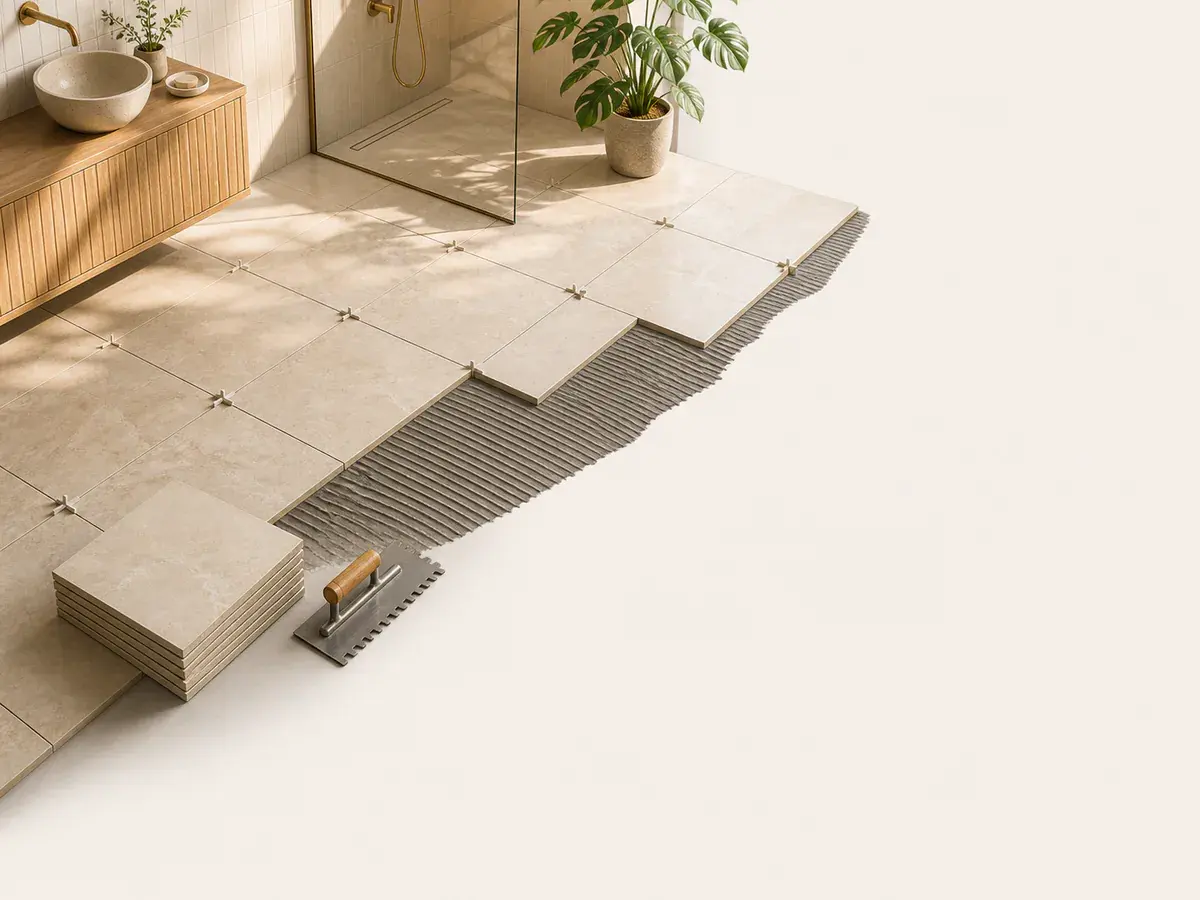
A decision you can check
- 01
Non-porcelain ceramic
Often economical and easy to cut for interior walls and suitable rated floors. Confirm the product's stated use instead of assuming all ceramic belongs only on walls.
- 02
Porcelain tile
Dense porcelain can suit demanding wet or traffic areas when rated for them. It may require suitable cutting tools and mortar coverage practices.
- 03
Natural stone alternative
Stone brings different absorption, movement, sealing and substrate considerations. It should not be substituted into a ceramic-tile specification without reviewing the assembly.
- 04
Confirm the complete system
Compare the selected tile installation with preparation, accessories, labour, maintenance and replacement needs. Record the exact product rather than carrying a generic category into the order.
Compare performance before price
Floor approval, wet-area suitability, slip information and freeze-thaw exposure are separate product characteristics.
Large-format porcelain can need a flatter substrate even though it has fewer grout joints.
- Non-porcelain ceramic
- Porcelain tile
- Natural stone alternative
Use the calculator without hiding the choice
Keep the verified project dimensions fixed in the Tile Calculator, then change only the package coverage, unit size or waste assumption that belongs to the selected tile installation. This shows the cost of the decision without changing the room or site.
A successful installation is a system of substrate, waterproofing or membrane, mortar, tile, movement joints and grout.
Approve a real sample and specification
Review the exact product or a representative sample in the project conditions, read the current technical data and write the locally recognized designation or product line, performance class, size, finish where relevant and accessory system into the purchase scope. Availability and installer experience can make a technically acceptable option impractical locally.
What usually throws the order off
- Selecting tile from ceramic or porcelain name alone
- Ignoring the product use rating
- Choosing grout before joint width
- Using grout in required movement joints
Frequently asked questions
Which tile installation option is best?
There is no universal winner. Use the ceramic vs porcelain tile criteria to eliminate options that do not meet the location, exposure, substrate or maintenance requirement, then compare complete installed systems.
Can I compare options by advertised price alone?
No. Convert each tile installation option to the same finished scope and include its preparation, accessories, delivery, installation, maintenance and replacement implications.
Can appearance or a sample approve the order?
No. A sample helps judge appearance; current technical documents establish performance, installation limits, warranty and the quantity or capacity represented by the exact tile installation.
Technical references
These references support the measurement and planning method. Product instructions, the site and applicable local requirements control the final installation.