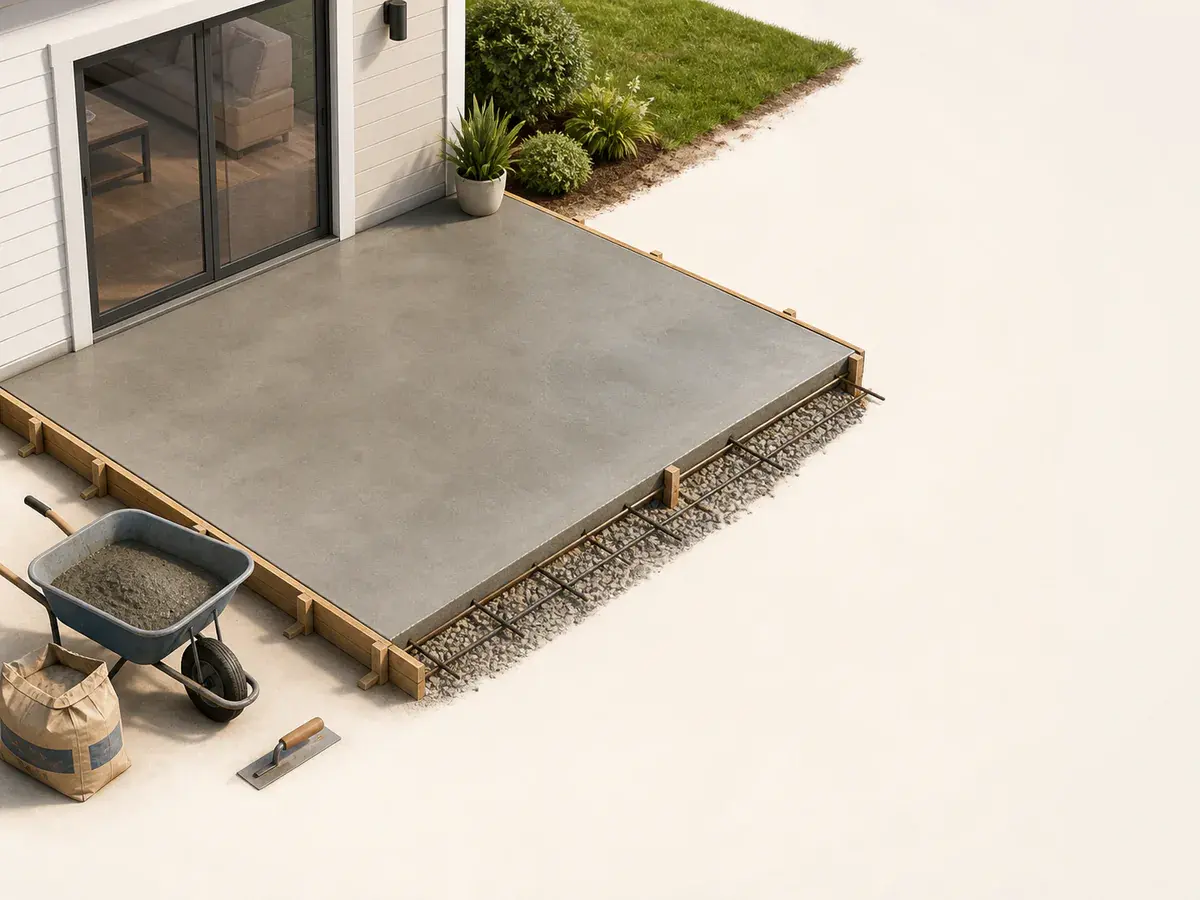
What a complete price should include
A useful estimate separates the base installation from preparation, removal and finishing. Check that every bid states the same scope before comparing totals.
- Excavation, compacted base and disposal
- Forms, specified concrete and reinforcement
- Placement, finishing, joints and curing
- Grade transitions, cleanup and stated permits
Cost drivers that change the quote
Shape and formwork
Straight parallel edges set quickly. Curves, steps, widening and multiple elevations use more stakes, flexible forms and finishing time even at the same area.
Preparation and drainage
Current guidance places grading and demolition additions around $200 to $1,000. Weak soil, roots and a missing runoff outlet can expand the scope.
Finish and access
Broom finishes are usually economical. Stamping or color can add roughly $2 to $12 per square foot, while pumps and hand-carry routes raise placement cost.
DIY versus professional installation
A short isolated walk may suit an experienced crew, but forms, slope, continuous placement and finishing cannot pause once concrete arrives. Public sidewalks, accessible routes, steps or drainage conflicts need local approval and professional execution.
Questions to put in the written quote
- Finished area, thickness, slope and elevations
- Excavation, base and spoil disposal
- Concrete specification, joints and curing
- Finish, access, permits and restoration
Frequently asked questions
Is a four-inch walkway always enough?
Four inches is common in current market examples, but vehicle crossing, soil, frost and local requirements can call for a different section.
Does the price include removal?
Not automatically. Existing pavement, roots, grading and disposal should be explicit line items.
Why calculate cubic yards if quotes use square feet?
Square-foot rates help compare bids, while volume verifies that thickness and concrete delivery agree with the actual geometry.
Sources and update basis
Prices vary by location, access and specification. Market-price references establish the planning range; official and industry technical references support the safety, measurement and scope guidance. Neither replaces a local written quote, product instructions or applicable code.